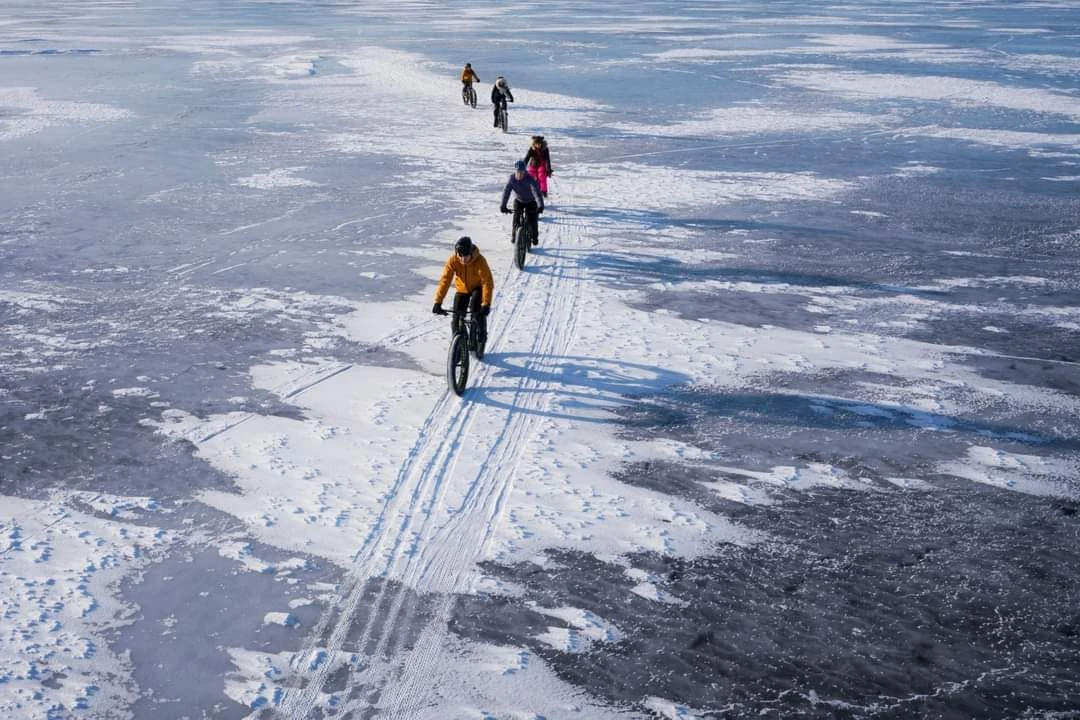
Every winter the Gulf of Bothnia freezes solid off the coast of Oulu, and when conditions allow, we ride straight out onto it. The city skyline sits low on one side, an open white horizon stretches out on the other, and there is nothing underneath you but ice.
What is a fatbike?
A fatbike is a bicycle with oversized, low-pressure tyres, typically twice the width of a normal mountain bike tyre. That extra surface area lets the bike float over snow and ice instead of sinking or slipping, which makes riding on a frozen sea not just possible but genuinely easy.
If you can ride a bike, you can ride a fatbike. There is no technique to learn, and most guests forget they are on unusual equipment within the first few minutes.
What the ride is like
We start at our Experience Center on the Nallikari seafront. After a safety briefing and a short introduction to the bike, we head out along snowy forest trails and the Nallikari shoreline, and when the ice and snow conditions allow, out onto the frozen sea itself.
Some days the snow on the ice is too deep or soft for riding. When that happens, we take the winter landscapes of Nallikari and Hietasaari instead, which are beautiful in their own right, with quiet snowy forests and parkland right by the water.
The pace is relaxed. This is not a fitness challenge. It is a two-hour ride through a landscape that most visitors have never seen before, with stops for photos and stories from your guide.
Why it is worth doing
Plenty of Arctic destinations offer snowmobiles and husky sledding. Very few offer this. Cycling on a frozen sea is rare, quiet, low-impact and, honestly, a little surreal. It also produces the single best photo most people take on their trip.
There is another advantage worth mentioning: it is silent. No engine, no noise, just tyres on snow and the enormous stillness of a frozen sea.
Do you need experience or fitness?
You need basic cycling skills and basic fitness, nothing more. The route is flat, the pace is comfortable, and the guide adjusts to the group.
Thermal overalls, boots, gloves, a hat and a helmet are all included, along with the bike itself. Bring warm layers to wear underneath and you are set.
When can you do it?
Our Arctic Sea Bike Experience runs from 22 December to 31 March, when the sea ice is reliable. Midday departures are common, giving you the best of the short Arctic daylight, and the low winter sun makes for extraordinary light on the ice.
In summer the same fatbikes take a completely different route, through Nallikari's beaches and forests to the historic island of Pikisaari and the parks of Hupisaaret on our Oulu Cultural Bike Tour. Fatbikes handle sand and forest trails just as comfortably as snow.
Frequently asked questions
Is cycling on a frozen sea safe?
Yes, when guided. Our guides assess ice and snow conditions before every departure, and we only ride on the ice when it is thick and stable. If conditions are not right, we take forest and shoreline routes instead.
Do I need to be fit?
Basic fitness is enough. The terrain is flat and the pace is relaxed.
Do I need my own bike or winter clothing?
No. The fatbike, helmet and full thermal clothing are all included.
Can beginners do it?
Yes, as long as you can ride a normal bicycle. There is no learning curve beyond the first few minutes.
What if there is no ice?
We ride the snowy forest trails and shoreline of Nallikari and Hietasaari instead, which are scenic and just as enjoyable.
Ride the frozen sea
Our Arctic Sea Bike Experience departs from the Nallikari seafront throughout the winter season, guided in English, with bike and warm clothing included.
Book the Arctic Sea Bike Experience
Groups welcome, up to 50 riders. Contact us for group and tour operator rates.